
Post
How to Use a VPN on a TV: Apps, Routers and Smart DNS Limits
Choose a TV VPN setup by operating system and player. Compare supported apps and router configurations while keeping Smart DNS separate from encryption.
In this article

Cover: AI-generated editorial illustration of an everyday device setting; not a product screenshot or evidence of testing.
To use a VPN on a television, first identify the operating system and exact model. If the provider offers a supported app for that platform, install it from the official device store and follow its setup instructions. If it does not, a compatible router or another documented arrangement may be necessary. Smart DNS is a separate option and does not by itself create an encrypted VPN tunnel.
The brand printed on the television is not enough to choose instructions. Different models from the same manufacturer can use different software. A streaming box connected to the television is also a separate device. Start with the device actually running the viewing application, rather than assuming the display itself needs the installation.
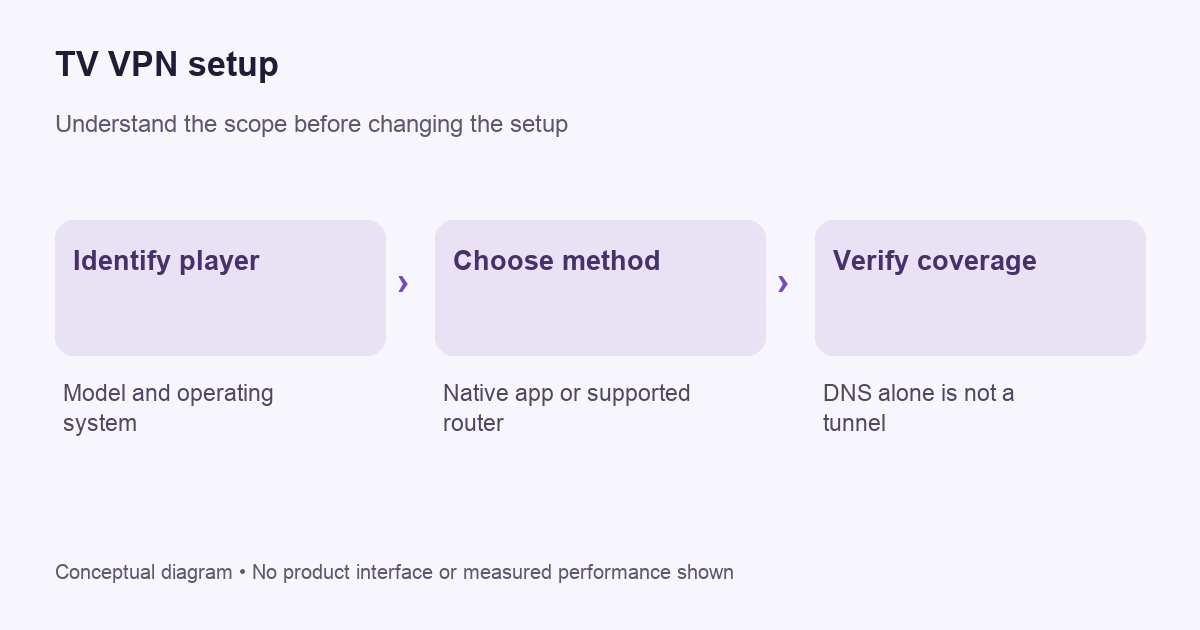
Identify where the streaming application runs
Open the device’s system information and record the model and software version. Note whether you use its built-in apps, an Android TV box, a Fire TV device, an Apple TV, a console or another connected player. Keep that information beside the provider’s compatibility page when checking support.
This simple inventory avoids an expensive mismatch. A provider can support one connected streaming box without offering an app for the television’s built-in operating system. The HDMI connection between them does not mean their software is interchangeable. Choose the instructions for the player you use.
Use a supported native app where available
ExpressVPN’s current device list distinguishes native app platforms from devices requiring other configurations. Its Android TV instructions describe installation through the device’s Play Store for supported versions. These are examples of provider-specific support, not a promise that every television can install the same application.
Use the official store listing and confirm the publisher. Complete account access using the provider’s documented method, then connect and check ordinary viewing. Keep account codes private; a code displayed on a television can still grant access to your subscription. Do not post a screenshot of an active pairing screen in a public support thread.
Apple TV: use a supported tvOS app before considering older workarounds
Apple TV hardware, the Apple TV app and an Apple TV subscription are different things. Installing a VPN on a compatible Apple TV box changes the connection used by that device; it does not add a VPN to every television that happens to offer Apple’s viewing app. Identify the box and software version before choosing instructions.
Apple introduced third-party VPN app support with tvOS 17. On a compatible device, check Settings, System and Software Updates for the available update. Keep the box powered and connected while an update installs. A minimum version in a provider’s instructions is a compatibility requirement, not a reason to avoid newer supported security updates.
ExpressVPN on a compatible Apple TV
ExpressVPN’s current setup guide supports its native app on tvOS 17 and later. Install the official App Store listing, open it and sign in through the account method shown. Follow the prompts to add the VPN configuration, then connect in the app. Treat pairing codes and sign-in screens as private account information.
Check the app’s connection state on the Apple TV itself. To change the tunnel location, use the VPN app’s location controls; changing the television’s language or an Apple account’s store region is a different operation. Reopen the viewing app and check normal playback. A successful tunnel does not guarantee access to a specific title or replace the viewing service’s subscription.
| Route | When to investigate it | Important distinction |
|---|---|---|
| Supported native VPN app | Compatible box and current provider app | The app controls that device’s tunnel; verify its actual status. |
| Compatible router VPN client | Older hardware or a network-level requirement | Routing applies to selected devices on that network; check the router’s client support. |
| MediaStreamer or another Smart DNS service | A provider documents that route for the exact device | DNS configuration alone does not provide VPN tunnel encryption. |
Decide whether the extra setup solves your problem
You do not need to buy a VPN simply because you own an Apple TV. Name the requirement first: a supported encrypted route, an existing household subscription, or another documented use. If ordinary viewing already works and you have no additional requirement, a promotion is not a technical reason to change the setup.
If the box cannot run a supported app, compare a maintainable router option with using another compatible player. Avoid archived fixed DNS addresses and generic “Create a VPN” menu instructions. For purchase terms, use our current ExpressVPN offers; the old article’s percentage discount and device allowance are not current plan evidence. Keep troubleshooting specific to the box, network and viewing service you actually use.
Keep Smart DNS separate from VPN encryption
A provider may offer a DNS-based setup for a device without a native VPN app. Its purpose and coverage need to be read separately. Changing DNS settings does not, by itself, mean all television traffic is traveling through an encrypted VPN tunnel. Avoid calling a DNS configuration “the VPN” merely because the same subscription includes both services.
Before choosing that route, ask what problem you need to solve. If the requirement is an encrypted connection for the player, a DNS-only arrangement does not establish it. If the requirement is a provider-supported viewing configuration, follow the exact documented scope and restrictions. Our intermediary comparison explains why service labels are not enough.
A router option affects more than the television
A compatible router can apply a VPN route to devices using the selected network. Compatibility is specific: having a VPN server setting is not the same as supporting a client connection to your chosen provider. Check the router model, firmware and supported configuration before buying hardware or changing settings.
Read our router setup guide before proceeding. Save a recovery path and identify which household devices will be affected. If the router supports a separate network or device rule, use its official instructions to understand the scope. Do not assume every connected gadget should share the television’s route.
Verify normal use before judging performance
Establish that the viewing service works on the ordinary connection first. Then make one supported change and repeat the same harmless task. Record whether the symptom concerns signing in, loading the catalogue, starting playback or sustaining playback. Those observations distinguish different problems and make a support request more useful.
A phone beside the television is not proof of the television’s route. It may use mobile data, another network or its own VPN app. Check the actual player with the provider’s supported diagnostics. If those do not offer an address check, ask how to verify the configuration rather than inventing certainty from a nearby device.
Do not promise access to every catalogue
A working VPN connection does not guarantee a streaming service will accept it or offer a particular title. Content availability, account eligibility and service terms are separate questions. Use the viewing platform’s official guidance and the provider’s current support information. VPNBlade has not tested every television and catalogue combination for this article.
Our streaming comparison guide and Netflix guide focus on those buying checks. Treat compatibility statements as things to verify for your setup, not as permanent access guarantees. Avoid purchasing a long subscription based on one unqualified “works everywhere” claim.
Troubleshoot one layer at a time
- Confirm that the player has ordinary internet access.
- Check the VPN account and connection status.
- Confirm that the player uses the intended network or app.
- Identify whether one service or all applications fail.
- Check current service and provider support notices.
- Restore the previous configuration if the optional change does not help.
Do not change DNS, router routing and player settings simultaneously. If playback improves afterward, you will not know which change mattered. Keep a short record of the model, software version, provider app version and symptom. Use our troubleshooting process when preparing a redacted support request.
Check remote control and recovery usability
A technically supported app still needs to be usable from the sofa. Check the documented connection controls, sign-in method and recovery instructions for the television interface. Consider what happens after a software update, a restart or an expired login. Keep the provider’s support link available on another device.
If several people use the player, explain the selected configuration and its limitations. A household member should know whom to ask before resetting the network to solve a viewing problem. Clear ownership of the setup reduces accidental changes and unnecessary troubleshooting.
Compare the complete subscription cost
Confirm the required television support before comparing prices. Our ExpressVPN store and Surfshark store provide dated offer records, while provider documentation determines current app compatibility. Router hardware, optional features and subscription renewals can change the total cost.
Use the buying checklist to compare the full initial payment, refund conditions and cancellation route. These cards are billing references rather than a claim of tested streaming performance or guaranteed access to any particular service.
NordVPN on Fire TV: verify the generation before installing
NordVPN’s current Amazon-device instructions use the Amazon Appstore. They exclude the first-generation Fire TV Stick and identify the second-generation Stick and Basic edition as too old for the current NordVPN app. The same page notes temporary feature limitations on newer Vega OS devices. This is why an archived claim that every Firestick works is too broad.
- Record the exact device generation and operating-system version.
- Check the provider’s current compatibility page and the app listing on that device.
- Install the official app where supported, then use its documented account sign-in.
- Connect, reopen the viewing app and check normal playback and reconnect behavior.
A supported download does not prove that every desktop feature exists on the TV version. Check the controls you need in the actual TV documentation before buying a long plan. If an app is unavailable, avoid a random modified APK promoted as a universal fix. A different supported streaming device or the router-client route may be a more maintainable option.
Samsung, LG and Roku: choose the route your platform supports
NordVPN’s TV setup overview separates native apps, router configuration and documented connection sharing. Its Android TV compatibility page directs Tizen, webOS and Roku OS users toward a router rather than the Android TV app. These are NordVPN-specific instructions; do not generalize them into a claim that no VPN provider can ever support any model of those platforms.
| Viewing platform | Practical starting point | Check before subscribing |
|---|---|---|
| Compatible Fire TV device | Official Amazon Appstore app | Generation, OS and current feature availability |
| Samsung TV running Tizen | Compatible router or supported external player | Which device actually runs the viewing app |
| LG TV running webOS | Router route; SmartDNS is a separate documented option | Encryption requirement versus DNS-only configuration |
| Roku player or Roku TV | A supported network-level route | Actual gateway, DNS behavior and reconnect recovery |
Do not copy a Windows connection-sharing recipe into a phone-hotspot tutorial. Sharing an ordinary network connection and sharing traffic already routed through a VPN are separate operations. If you rely on a shared connection, check the provider’s instructions for that exact operating system and test from the receiving TV or player. A connected indicator on the computer alone does not demonstrate that the TV uses its tunnel.
LG SmartDNS is not the same protection as a VPN tunnel
NordVPN publishes LG SmartDNS setup instructions. They require account activation associated with the network’s public address before changing the television’s DNS configuration, and note that menu steps vary by model. Use the current official addresses and your own account; do not reuse another household’s activation or assume a screenshot from an old model matches yours.
The provider’s SmartDNS explanation explicitly distinguishes this feature from VPN protection and says supported streaming services can differ. If encrypted TV traffic is the requirement, replacing DNS values alone does not meet it. If the public address changes, revisit the account’s activation requirements before blaming the TV app. Keep the original DNS setting so you can restore it deliberately.
For a purchase, compare current streaming VPN features and trade-offs and the NordVPN store’s current offers after compatibility is established. Expired archived prices and universal unblocking claims are not current evidence. The live deal cards elsewhere in this article show plan records; they do not establish that VPNBlade tested your particular television.
Recovery review: Related archived topics consolidated on 27 October 2026, with current primary documentation replacing old compatibility assumptions and unsupported claims.
NVIDIA Shield TV: use the Android TV installation route
Shield TV is an Android TV device, so start with the TV-specific app rather than a phone tutorial or an assumption that every smart television runs the same system. NVIDIA’s user guide describes its Google Play Store app route and both Wi-Fi and Ethernet connectivity. Record the Shield model, installed system version and network connection before choosing a VPN. That identifies the platform you actually need to support.
ExpressVPN’s current Android TV instructions explicitly include NVIDIA Shield and specify Android 7.0 or later for the documented store procedure. Search for the genuine provider app in Google Play on the Shield, install it and complete the provider’s supported sign-in and connection flow. A provider’s desktop feature list is not evidence that the TV app has identical controls. Check the TV-specific settings that matter to your household before buying a longer subscription.
| Stage | Check | What the result establishes |
|---|---|---|
| Before installation | Ordinary playback and the network connection work | A baseline for separating an existing service fault from a VPN problem |
| After connecting | The TV app reports the intended connection and a permitted task works | A limited check of that device and task, not a universal streaming guarantee |
| Local discovery | Required casting and private media access still work | Whether the current routing policy permits the local workflow |
| After restart | Connection state and essential tasks are checked again | Whether the routine startup behavior meets the requirement |
Keep casting and network storage separate from internet playback
NVIDIA’s casting instructions require the sending device and Shield to share the same network. Its guide also describes adding network storage for private media. If connecting the VPN interferes with discovery, diagnose the local-network requirement separately from internet access. A VPN app on your phone does not, by itself, establish which route a separate TV device uses.
Write down which local resource must remain reachable before adding an exception. Then check both the local task and the intended internet task. Do not disable the household firewall or remove unrelated network controls merely to make discovery work. If private media lives on a NAS, our Synology and QNAP guide explains why the storage device’s outbound route and remote access to its files are different requirements.
Choose supported installation and honest expectations
Start with the official store route when it is available. If it is unavailable, ask the provider for the supported procedure for your exact device instead of downloading an APK from an unrelated mirror. Keep the current app version and a supported disconnect or uninstall route available. No factory reset is required simply because a VPN connection fails.
Compare providers by current TV compatibility, the controls you need, subscription terms and a repeatable household check. A VPN connection does not guarantee access to every streaming title, eliminate buffering or make a service account unrecognizable. The commercial offers elsewhere in this article remain billing references; neither their placement nor an archived author’s claimed test establishes measured Shield performance.
Google TV apps and Chromecast casting use different connection paths
First identify the device and the task. An older Chromecast receiver, a Chromecast with Google TV and a television with Google TV should not be treated as one identical installation target. Running a TV app directly and sending media from a separate phone or computer also create different troubleshooting questions. A working VPN on the sending device does not by itself prove that the receiver’s media connection takes the same route.
Google’s current casting guidance requires the sender and Google TV or Cast receiver to share the same Wi-Fi network. Its help also distinguishes a missing Cast destination from playback after a device has been discovered. Start by recording which stage fails. A device absent from the Cast list is not automatically evidence of an unsuitable VPN subscription, a streaming block or a need for a dedicated IP address.
| Observation | Investigate next | What changing VPN providers would not establish |
|---|---|---|
| No receiver appears | Same network, local discovery permissions, device setup and the supported casting route | That a purchase restores communication between isolated devices |
| Receiver appears but the app will not play | The particular app, service message and device’s connection state | That every playback problem is a tunnel failure |
| Native TV VPN app cannot install or sign in | Exact model, supported system, official listing and account workflow | That a phone setup procedure applies unchanged to the TV |
| Playback works until a restart | Startup, account and documented reconnect settings | That the earlier successful session proves later coverage |
A supported NordVPN route for an Android TV-based device
NordVPN’s Android TV instructions provide an official app or Google Play route, followed by account sign-in through a displayed QR code or remote-validation number. Use the code shown by the genuine app and keep account information private. Review the requested VPN connection permission for that intended app. Then connect using its documented control and check the task on the TV itself.
The same support guide describes local-network discovery, app exclusions and connection settings. Those controls solve different problems: allowing a local device to be discovered is not the same as putting an application outside the tunnel. Confirm the current menu and the effect of any deliberate exception. Do not transfer every phone or Windows feature into the TV app because the provider name is the same.
If you are choosing a new supported TV subscription, our NordVPN offer records show general billing context. The following offer is optional purchase information, not a promise to repair casting or a dedicated-IP quotation. Compatibility and an ordinary connection check come first.
Check current NordVPN offers and verification dates →
Review local-network permission on the sending device
Google documents Local Network permission for Cast-enabled apps on iOS 14 and later and for Chrome on macOS 15 and later. If discovery is the problem, inspect whether the intended application has that permission. Granting it is a deliberate choice to let the app find devices on your local network; it does not supply a VPN connection or prove anything about a streaming service’s catalogue.
On a guest, hotel or managed network, ask the administrator about supported casting. Do not remove required isolation or weaken the household firewall simply because two devices cannot see each other. A network name that looks similar is also a poor substitute for checking the actual connection. Keep a simple record of the sender, receiver and network during diagnosis.
Use a controlled comparison instead of a firmware recipe
Google’s missing-destination guidance includes checking whether a VPN or proxy prevents communication from the laptop. If a permitted ordinary-route comparison is appropriate, understand any persistent blocking settings first and restore the intended configuration afterwards. The result concerns that local communication path; it is not an independent assessment of a provider’s privacy or speed.
If you intentionally use a router VPN, follow the supported router setup checklist for the exact model and firmware. Do not flash a generic downloaded file or treat router installation as an automatic casting fix. For a task that still fails, record the exact message and take it to the platform or provider support team. Our connection troubleshooting guide helps keep account, tunnel, discovery and service errors separate.
NordVPN SmartDNS: separate account activation from device setup
NordVPN’s current instructions require allowlisting the original public IPv4 address, with the VPN disconnected, then activating SmartDNS in Nord Account. The provider says activation can remain pending for up to ten minutes and does not currently support IPv6 for this activation. Those requirements are separate from entering DNS values on a television.
| Stage | Useful observation | Next question |
|---|---|---|
| Account activation | The account shows pending or active. | Was the intended network’s original IPv4 address registered? |
| Device configuration | The TV saved its DNS setting. | Did you follow the current instructions for that exact model? |
| Playback | The requested service works or returns an error. | Does the provider currently support that service and region? |
A saved DNS setting alone does not establish that activation completed. Likewise, an active account setting does not prove the TV saved the right configuration, and neither promises access to every streaming catalogue. Keep the service’s exact error separate from the account’s activation status when asking for help.
If you change networks, check the address and account association again before repeatedly editing the television. Preserve the original DNS setting so you can return to the previous arrangement. For an encrypted connection, use the native-app or router decision earlier in this guide; SmartDNS activation does not establish that protection.
ExpressVPN on Chromecast with Google TV: check the controls after installation
Google TV’s app search can install an available app from its listing, but a completed installation is only the first checkpoint. Google describes finding the app by search or from the Apps tab and selecting Install. Confirm the intended publisher and compatible device before subscribing. An app being present on a phone does not establish that it is available on the television.
ExpressVPN’s current Chromecast with Google TV instructions describe an app-store installation followed by sign-in and a VPN configuration permission. Approve the login you initiated on your own TV. If using its QR or displayed-link workflow, confirm that the destination is the genuine provider before entering account information. Do not approve a device login merely because an unsolicited message supplies a familiar logo.
Connection protection is a setting, not an installation result
The same ExpressVPN guide says its kill switch is off by default. It places the control under Options, Settings, Network protection, with a setting to block internet when the app cannot connect or reconnect. Review the actual control on your installed version. The guide also says that a change to split tunneling takes effect on the next reconnection. These are product-specific instructions, not a description of every Google TV VPN.
Write down any deliberate app exclusion before checking playback. Otherwise, a streaming app working successfully may be mistaken for evidence that it used the intended tunnel. Similarly, automatic connection at startup and blocking when a connection drops address different events. Neither should be inferred solely from having signed in once.
A TV setup handover record
| Record | Why it helps |
|---|---|
| TV model, system and VPN app version | Identifies the instructions and maintenance requirements that apply |
| How the genuine app was installed | Separates a supported store workflow from a copied APK tutorial |
| Connection, startup and blocking settings | Makes the intended behavior explicit instead of assuming defaults |
| Any app exclusions | Explains why two applications may use different routes |
| An authorized playback task and result | Creates a repeatable check without promising every catalogue will work |
For example, if playback works before a restart but not afterwards, compare the saved startup and connection state before replacing the subscription. If casting alone fails, use the local discovery checks earlier in this guide. This is a diagnostic example, not a measured ExpressVPN test. A provider’s optional commercial offer cannot establish which configuration your TV actually uses.
Our kill-switch explanation and split-tunneling guide cover the separate purposes of those controls. Compare the current subscription bill only after confirming the supported app route. Archived promotional prices, universal dedicated-IP claims and claims of guaranteed buffer-free access are unsuitable substitutes for that check.
LG and Samsung TV: separate a DNS service from VPN protection
ExpressVPN’s current Samsung and LG setup guides describe MediaStreamer as a DNS service, not a VPN. The provider says it does not provide VPN privacy and security benefits and cannot change locations. A TV reporting successful internet access after a DNS change therefore does not establish an encrypted VPN route. This distinction matters when comparing a DNS setup with a compatible router or shared VPN connection.
Use the guide for your model, then keep a way back
The Samsung instructions, updated 29 September 2026, identify a Crystal UHD DU8000 as the tested example. The LG instructions, updated 4 August 2026, identify webOS version 10.3.0-250. Those are provider-reported examples, not VPNBlade tests and not proof that every model has identical menus. Note the exact television model and system version before changing network settings.
Both guides describe registering the network’s IP address in the provider account and obtaining the assigned MediaStreamer DNS values there. Do not copy a DNS address from an old coupon article. Account registration and the TV’s DNS field are different checkpoints; save the status of each when asking for support.
ExpressVPN describes restoring automatic DNS on both platforms: Samsung uses Get automatically, while the LG example uses Set automatically. Preserve the original configuration and consult the matching model instructions. Do not erase the TV’s complete configuration simply because a DNS service stops responding.
Surfshark SmartDNS is no longer a current alternative
Surfshark discontinued SmartDNS on 2 February 2026. Its official notice says existing users need to remove the retired settings and offers supported router, Windows hotspot or compatible native-TV-app routes instead. A public DNS resolver is not a replacement encrypted VPN service. Check what the provider supports today before buying a subscription for a feature shown in a 2023 television guide.
Keep a three-part television support record
| Layer | Record | Question it helps answer |
|---|---|---|
| Account | Chosen service and registration status, without passwords | Is the intended network recognized by that service? |
| Television | Model, system version and original versus changed DNS setting | Did the supported device configuration save correctly? |
| Playback | App, authorized task and exact error message | Is this a general connectivity failure or a problem confined to one service? |
For example, a TV may browse normally while one streaming app fails. Repeatedly buying another plan would not explain whether that failure concerns account access, service availability or the local setup. Start with the recorded observations. If your actual requirement is an encrypted route, follow the router setup checklist or a documented supported client route; a DNS-only success message answers a different question.
The commercial offers in this guide remain optional billing information. They do not turn a retired feature into an available one, provide a native application for every TV or guarantee access to a particular programme.
YOUR EXPERIENCE MATTERS
Was this article useful?
Genuine reader helpfulness ratings. These do not measure VPN performance or verify a purchase. Only moderated submissions count. Ratings may reflect earlier versions of this information.