
Post
Does a VPN Protect You from Viruses? What Each Security Tool Does
A VPN tunnel does not replace antivirus. Separate routing from file protection, evaluate bundled features and check the active security provider.
In this article

Cover: AI-generated editorial illustration of an everyday device setting; not a product screenshot or evidence of testing.
A VPN tunnel is not a substitute for antivirus protection. It changes how covered traffic travels between your device and a gateway; it does not automatically inspect and remove every harmful file or stop a malicious program already running on the device. Some VPN subscriptions include separate security features, but those features need their own compatibility and scope checks.
This distinction helps when a product is sold as an all-in-one security bundle. Ask which component performs which job. A connected VPN indicator describes the tunnel’s state, not the result of an antivirus scan. A bundle can be convenient without making every feature identical or active on every supported device.
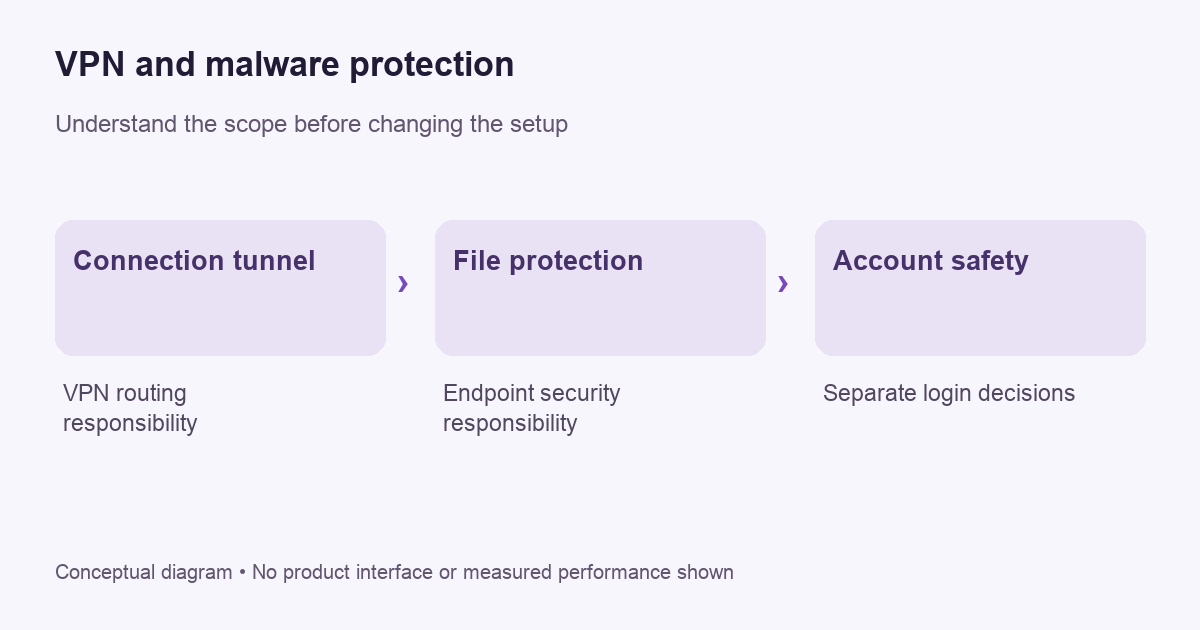
Separate connection protection from endpoint protection
Our VPN fundamentals guide explains the tunnel boundary. A protected route does not decide whether the file at the end of a download is safe. If you authorize a harmful program to run, changing the route used to fetch it does not make its behavior harmless.
Microsoft’s Windows Security guidance describes a separate virus-and-threat protection interface, including scanning, protection settings and security-intelligence updates. Those are endpoint-security functions. They should not be inferred from a VPN subscription unless the provider actually supplies a supported feature with that purpose.
Read bundled extras individually
A provider may advertise website blocking, download scanning or another protective feature alongside the VPN. Check whether the feature is included in your exact plan, available on your operating system and enabled in the current app. Do not transfer a desktop feature to a phone solely because both use the same account.
Also ask what the feature does not inspect. A domain-blocking control, a file scanner and an installed antivirus engine have different scopes. Marketing can place them beside each other on one pricing page, but that layout does not make them interchangeable. Keep each claim attached to the component and documentation that supports it.
A useful everyday security check
On Windows, use the official Windows Security interface to identify the active protection provider and review its status. Microsoft’s file-scanning instructions explain checking a specific item and confirming the active antivirus provider. Follow current device guidance rather than relying on a VPN app’s green connection icon.
For another operating system, use its official security documentation and the installed security product’s instructions. Avoid applying Windows menu names to a different device. The important habit is identifying the component responsible for the task and checking that component directly.
Do not disable protection to make a download work
If a security product flags a file, pause and investigate the source. Do not assume it is a false positive merely because the file arrived over a VPN. Check the publisher’s official download channel and the security product’s documented process for reviewing the result. An unfamiliar website asking you to turn off protection is not reliable evidence that doing so is necessary.
Keep the decision separate from network troubleshooting. A download that fails because of a connection problem and a download blocked because of a threat alert need different investigations. If you change both routing and security settings at once, you can lose the information needed to distinguish them.
HTTPS and VPNs do not judge a site’s intentions
HTTPS protects the application connection using TLS. That is valuable, but an encrypted connection can still lead to a dishonest service. Likewise, a VPN can carry a request to a site without establishing that the site’s claims are true. Encryption protects a connection property; it does not certify the business at the other end.
Before entering credentials, check that you reached the intended official destination. Use a saved trusted route when practical. Do not treat a familiar logo, a sponsored result or a message claiming urgent account trouble as sufficient evidence. A network privacy tool cannot make an incorrect destination correct.
What to do if you suspect an infection
Use the operating system or security vendor’s current response guidance. Save the exact alert and time, avoid unnecessary further interaction with the suspicious file, and contact the appropriate support channel. On a work device, notify the organization’s IT or security team rather than attempting an improvised cleanup that could destroy useful evidence.
A VPN subscription is not an incident-response plan. Do not claim the issue is resolved merely because the public address changed. If important accounts may be affected, use the relevant service’s official recovery and security instructions from a device you can reasonably trust. Keep account recovery separate from unsupported guesses about the network route.
Keep software and support ownership clear
Write down which product handles tunneling, which handles endpoint protection and who supports each. A bundle can involve separate apps or settings. That inventory makes a failure easier to describe: “The VPN connects, but the security scanner shows this alert” is more actionable than saying the whole security package is broken.
Review the inventory after installing or removing software. An expired subscription or a changed security provider can alter what is active. Use the official interface to confirm the state rather than assuming the previous configuration remains in effect. Avoid adding overlapping tools just to make the list look more complete.
How to compare a security bundle
| Check | Evidence to seek |
|---|---|
| VPN coverage | Current app and routing documentation for your platform |
| Threat protection | The named feature’s actual inspection scope and limitations |
| Device support | Eligibility for each component, not only the bundle name |
| Billing | Initial payment, renewal, cancellation and component-specific terms |
The table is a buying framework rather than a product test. VPNBlade has not tested malware samples for this article and does not assign a detection score. Look for appropriately scoped independent evidence where comparative detection performance matters.
Use deal records without confusing the product tier
Our NordVPN and Proton VPN stores contain dated offer records. A general VPN plan card does not establish that a particular antivirus or security add-on is included. Confirm the exact tier and supported features with the provider before purchase.
Read the VPN buying checklist alongside the component documentation. Choose the tunnel for a defined networking need, maintain the appropriate device protections, and keep the responsibilities of each tool explicit.
Antivirus vs VPN: choose the component for the job
The archived VPNBlade antivirus-versus-VPN article asked a useful question, but its blanket feature claims needed correction. A product category is not a guarantee that every subscription includes a firewall, a password manager or file scanning. Use this comparison to identify the component to investigate, then read the documentation for the exact plan and device.
| Your immediate need | Component to check first | What would count as useful evidence? |
|---|---|---|
| A suspicious downloaded file | The active endpoint-security product | A scan result and the publisher’s documented response process; a connected VPN indicator is insufficient. |
| A protected route across unfamiliar Wi-Fi | The VPN application and routing configuration | Supported platform settings and a check of the intended route, alongside HTTPS. |
| An unexpected account sign-in | The account’s security and recovery controls | Review the service’s activity record and follow its official recovery guidance. |
| A bundled website-blocking claim | The named filtering feature | Its documented scope, supported device, plan eligibility and current enabled state. |
Can you use both?
A VPN and an endpoint-protection product can have different responsibilities in the same setup. That does not mean every combination of applications will work without configuration. Follow the relevant vendors’ compatibility guidance. If a problem begins after installing a bundle, identify which component changed before adding exclusions or removing another protection.
When comparing costs, list the functions you already have and the additional function you actually need. A lower introductory price can still buy an unnecessary duplicate. Conversely, buying a VPN alone does not establish that an antivirus entitlement is included. Read the exact tier, renewal charge and device support before choosing an upgrade.
Our public Wi-Fi workflow shows where connection protection fits. The existing device-security guidance below addresses the separate endpoint question. This comparison restores the useful decision structure from the archive without carrying forward its expired offers, unsupported anonymity promises or product-detection claims.
Antivirus with a VPN: check the bundle before upgrading
A security suite can be a sensible purchase when you need both device protection and a VPN, but the word “included” needs closer reading. The archived VPNBlade bundle articles raised this buying question twice with nearly identical text. Their 2020 prices and sweeping promises do not establish what a current subscription supplies. Start with the exact product, country, operating system and entitlement, then compare the additional cost with the functions you already have.
A limited VPN and a full VPN entitlement are different purchases
Bitdefender’s current VPN FAQ gives a concrete example: its standard VPN allowance is 200 MB per device per day, with automatic server selection. It identifies a different allowance for Small Office Security. Premium VPN removes the traffic cap and permits server selection; some security bundles include that entitlement, while other customers need a separate subscription. A security-suite name alone therefore does not prove unlimited VPN access.
Check the account’s active entitlement before paying for an upgrade. If your bundle already includes the required VPN tier, buying another subscription may duplicate it. If it supplies only a limited allowance, decide whether that allowance fits your actual usage. A short occasional connection and an evening of video calls have different requirements. This is a purchase-planning distinction, not a measurement of Bitdefender’s speed or security.
Check each component’s device and regional limits
Norton’s current documentation distinguishes Norton 360 products from Norton VPN Plus and Ultimate packages. It also identifies component limits: Cloud Backup is Windows-only, Privacy Monitor availability is restricted to the US and Canada, and Dark Web Monitoring coverage varies by country or plan. These examples show why a long feature list should not be read as identical protection on every device. Confirm the current local offer rather than transferring a US product description to a different market.
| Before buying | Record this | Why it matters |
|---|---|---|
| VPN access | Exact tier, traffic allowance and server-choice rules | An included limited allowance may require an upgrade for your intended use. |
| Device security | Named protection component and supported operating systems | A tunnel connection does not confirm that an endpoint protection feature is installed or active. |
| Household coverage | Installation allowance and simultaneous VPN connection limit | Different components can have different coverage conditions. |
| Account and billing | Existing entitlement, new payment, renewal and cancellation terms | A bundle saving disappears if it duplicates a subscription you still pay for. |
When should you keep separate products?
Separate subscriptions can make sense when your existing device protection is suitable and you need a VPN capability that the bundle does not document for your setup. A bundle can make sense when its supported components meet both needs at an acceptable total cost. Neither arrangement is automatically safer. Make the decision using the specific functions and limitations, with support ownership clear if a connection or security alert needs investigation.
Compare VPN purchase requirements and our installation and account checklist before selecting a plan. The commercial offers elsewhere on this page are subscription options, not evidence that every displayed tier includes antivirus. Confirm the precise security add-on before using a deal button. We have not conducted malware-detection or bundle-performance tests for this comparison.
YOUR EXPERIENCE MATTERS
Was this article useful?
Genuine reader helpfulness ratings. These do not measure VPN performance or verify a purchase. Only moderated submissions count. Ratings may reflect earlier versions of this information.