
Post
Does a VPN make flights cheaper? Compare the final ticket, not a promise
Does a VPN make flights cheaper? Compare the final ticket, not a promise. Source-based analysis of current documented access, limitations, app controls and payment conditions, without invented tests or ratings.
In this article

A VPN is not a dependable shortcut to cheaper flights. Changing a connection’s apparent location may change the search context, but a lower number on one screen does not establish that the same ticket costs less at checkout. You must compare the itinerary, fare conditions, seller, currency and final payment total. We have not performed a new airfare experiment and do not promise savings from any VPN country.
This guide addresses the booking question rather than general travel-network protection. It uses Google Flights and Skyscanner’s own current documentation, reviewed on 31 October 2026. Our travel VPN guide covers preparing network access separately. A service useful for a supported travel connection is not automatically useful as a discount tool.
Separate location, currency and the ticket being sold
Google Flights says that its default experience depends on computer location and browser settings. Its location selector can affect available booking partners, payment methods and refund policies; language, location and currency can also be selected directly. That does not say that every location produces a lower fare or that changing an IP address makes a traveler eligible for every offer.
Use those visible settings before assuming that a paid networking tool is required to explore a different search context. Record what actually changed. If the currency changed while the amount became smaller, convert the final payable total before calling it a discount. If the seller changed, compare that seller’s conditions as well as its headline.
| Comparison field | Keep consistent or record explicitly | Why it matters |
|---|---|---|
| Trip | Flight numbers, dates, airports and passengers | A different itinerary is not a price change for the same ticket |
| Fare | Cabin, baggage and change conditions | A cheaper restricted fare may provide less |
| Seller | Airline or named agent | Support and payment conditions may differ |
| Money | Currency and final payable amount | A display conversion is not the card’s settlement cost |
| Timing | Search and checkout time | Sequential observations do not isolate one cause |
Do repeated searches prove that cookies raised the fare?
Skyscanner’s current explanation says it does not personalize its displayed prices using cookies, location or search history. It attributes changing results to the prices returned by airlines and agents and to factors including availability and demand. This is Skyscanner’s account of its own service, not independent proof about every airline, agent or booking platform.
That scope matters. A price increase after a second search does not, by itself, reveal why it happened. Switching a VPN, opening a private window and searching several minutes later changes multiple conditions. Without controlling them, you cannot confidently attribute a difference to one of those actions. A useful comparison record separates an observation from its explanation.
Private browsing may still have a role in managing a local browser session, but it should not be sold as a universal airfare discount. Nor should a VPN purchase be justified by a screenshot that omits the flight, fare family or checkout conditions. Ask for evidence of the same usable ticket at the final total.
Compare currency at payment, not only in search results
Skyscanner’s currency help notes that a booking partner may display or accept only certain currencies. It also warns that a bank or card issuer can use a different conversion rate and charge commission. Check with the payment provider about the actual conditions relevant to you; this article does not calculate an exchange rate or advise on a particular card.
Keep a comparison in one chosen currency for your own record, but retain the original currency beside it. Then inspect the seller’s final payment page. A superficially lower converted figure can disappear once payment conversion and required extras are included. Do not submit a false billing address or residency claim to obtain a displayed regional offer.
Baggage and transfers can explain a cheaper result
Google Flights documents a bags filter that includes selected carry-on or checked-bag fees in displayed comparisons. It says the baggage information comes from partners and that estimated fees can have additional taxes. Airline-specific size and weight rules still need checking. A comparison excluding a required bag is incomplete even if the base fare looks attractive.
Google also distinguishes its “Best” and “Cheapest” tabs. Lower-price results can include trade-offs such as self-transfers or using different airports, while rankings consider convenience as well as cost. This is a more concrete reason to inspect a result than assuming every lower fare comes from successful location switching.
For a trip with a fixed arrival deadline, write down the maximum acceptable stops and transfer complexity before searching. That prevents an apparent saving from replacing the trip you actually need with an option you cannot reasonably use. The right comparison is a usable itinerary with understood conditions.
Use price tracking for a defined trip
Google Flights permits tracking a route, dates or a particular flight and sending updates for significant changes. Flexible travelers can track an “Any dates” option. These are search tools, not guarantees that a later fare will be better or that every seller and offer is included.
Decide which choices are genuinely flexible: departure day, airport, trip length or carrier. Compare those one at a time. Record a satisfactory booking threshold and a practical deadline rather than endlessly refreshing because a VPN advertisement promises a secret cheaper country. If the trip is urgent, the cost of waiting is another uncertainty, not evidence for a particular technical trick.
A repeatable comparison without invented results
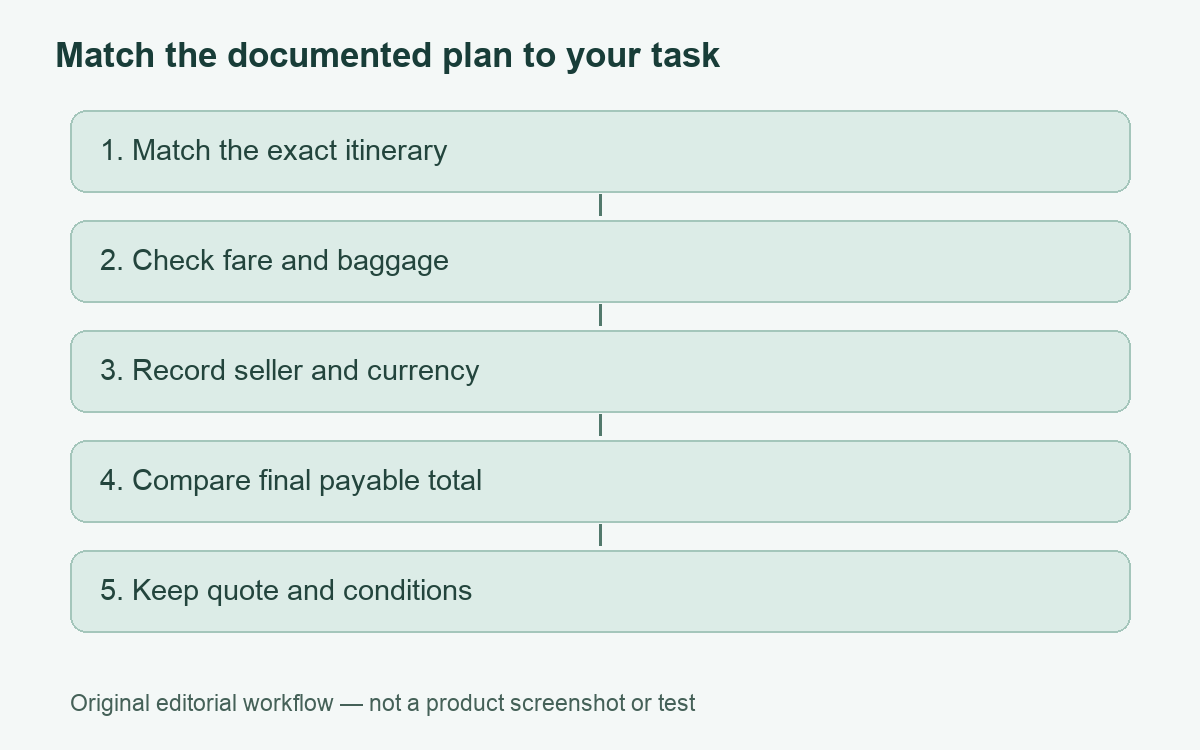
- Write the exact itinerary and necessary extras.
- Record the search tool’s location and currency settings.
- Compare the same fare through the actual airline and any agent you are considering.
- Check the final total, payment currency and relevant eligibility conditions.
- Save the quotation time and terms before deciding whether the offer is useful.
If you also compare while connected through a VPN, treat that as one recorded condition. Do not claim causation from a single difference, and do not continue through security warnings or misrepresent purchase eligibility. A booking site can apply its own access rules. We have not completed a purchase, tested a coupon or verified a region-specific checkout for this guide.
Buy a VPN for a networking requirement
Choose a VPN separately if you need a supported personal network service during travel. Review device support, availability and cancellation rather than estimating that hypothetical flight savings will repay the subscription. Our monthly versus upfront plan guide helps compare that commitment.
The optional inherited Proton plan below relates to ordinary personal VPN requirements. It is not an airfare offer, endorsement of a cheaper booking country or evidence that a paid plan will lower a ticket price.
The useful saving is a lower final total for an eligible ticket that still meets your needs. Establish that result directly instead of treating a VPN location as proof.
Cover: AI-generated editorial illustration, not a customer, product screenshot or evidence of testing.
YOUR EXPERIENCE MATTERS
Was this article useful?
Genuine reader helpfulness ratings. These do not measure VPN performance or verify a purchase. Only moderated submissions count. Ratings may reflect earlier versions of this information.